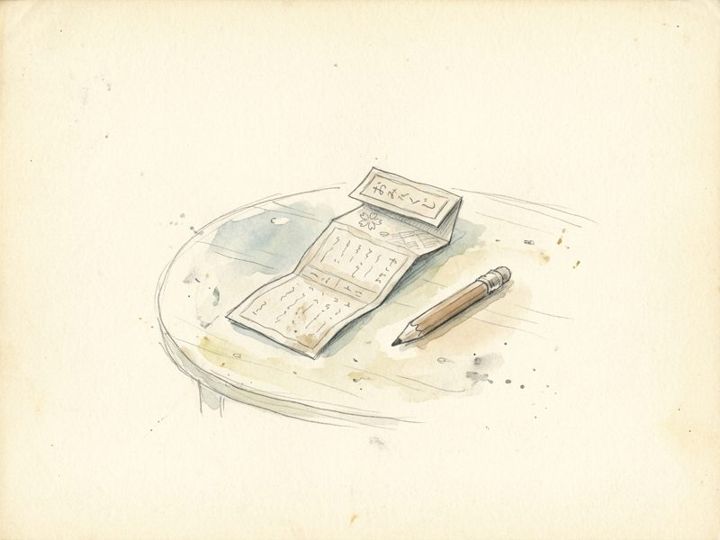
You're often the one who keeps everybody else's good news safe, aren't you? Here's how to keep your own good ones close to you.
And a slip that isn't so good never has to come home with you.
My friend Keiko taught me in Osaka in 1965, in a gravel yard that smelled of cedar.
There, the slip is called an Omikuji: a Japanese luck note, on folded paper. Keiko's steps are drawn below, so you can do them at home.
KEIKO'S STEPS
1. The box. A six-sided wooden box with a small hole at one end. You shake it gently and think about your day.
2. The stick. A thin stick slides out of the hole, with a number written on it.
3. The drawer. A wall of little wooden drawers. In the one with the same number, your slip is waiting.
4. A good slip. Keiko folded it in three, then in half, small enough for a purse or wallet. It stayed there until the next one.
5. A slip to leave behind. She folded it the long way into a thin strip and tied one knot around a pine branch. Then she walked off with her hands free.
Why pine? In Japanese, pine is matsu, which sounds like the word for wait. Keiko told me the slip waits there while you go home without it.
A slip to leave behind says nothing about you. It's about one day, and that day passes.
THE DAY I TIED UP A GOOD SLIP
Once, I tied up a good slip by mistake. I stood ten minutes at the branch, undoing knots to find it again.
Keiko laughed. She told me to leave it there, because a good slip tied up brings luck to whoever comes next.
Since then, when I get a step wrong, I think of the stranger who gets the good of it.
AT HOME
Your Omikuji comes in my letter, not on paper. To do it Keiko's way, copy its name onto a small scrap of paper, then:
- A good one: folded into your purse or wallet, until the next one.
- For family: a good one, tucked under the telephone.
- A slip to leave behind: tied outside, to a branch or the porch rail, and left there.
Once a good slip is folded in your purse or wallet, your fingers find it at the checkout, and it makes you smile.
If you forget a Wednesday, pick up again the next one. Nothing is lost.
Every Wednesday, a new Omikuji comes with my letter.
And yours: purse, wallet, phone or branch? Reply with one word to any of my letters. I read every reply myself.
I hope your next slip is one to keep.
Your good friend with the notebook,
Nola